
Why South Korea's Largest Internet Company is Acquiring a Cryptocurrency Exchange?
An analysis on how the merger between Naver Financial and Dunamu-Upbit ties together agentic payments, AI commerce, stablecoins, an Ethereum Layer 2, and RWAs.

Foreword
As an ex-early stage VC who has been active in the crypto space for several years, I find the interplay of traditional finance, Big Tech, and fintech partnering with crypto-native companies particularly fascinating. In Korea, blockchain unfortunately remains synonymous with the word “coin” (코인), reflecting a retail market focused primarily on trading and speculation rather than adopting blockchain as utility. This merger, however, breaks the mould. It positions Naver and Dunamu/Upbit to transform Korean users from speculators into everyday blockchain participants, leveraging Naver’s ecosystem for seamless UX.
English language coverage has treated Naver Financial’s full acquisition of Dunamu as a routine headline. The reality is far more profound, which is why I wanted to write this piece. Through this post, I wish to convey the significance of the largest internet company in Korea to fully acquire one of the top cryptocurrency exchanges in the world. Rather than a tactical M&A transaction, the deal frames stablecoins, tokenized assets, and agentic payment flows as a structural growth vector for Naver’s broader ecosystem, fundamentally reshaping how value and liquidity would circulate across the major internet platform that 52 million Koreans use as a daily basis.
Understanding Naver’s Dominance in Korea
Naver’s ecosystem combines the functionalities of Google, Amazon, YouTube, and PayPal into a single dominant platform. It has a market cap of roughly 36 trillion KRW (~USD $27 billion) as of late 2025, generating about 10.7 trillion KRW (~USD $8 billion) in annual revenue.
Search/Ads: including portal, news, blogs, maps, video
Accounts for 38-64% of Korea’s search market ahead of Google
Commerce: Naver Shopping, Smart Store, KREAM (resale platform)
Accounts for Korea’s 17-22% e-commerce share
Fintech: Naver Financial, Naver Pay, insurance, SME loans
Processed KRW 22.7 trillion in payments in Q1 2025
Content: Webtoon (online comics), SNOW (camera app), ZEPETO (Asia’s largest metaverse), AudioClip (Podcast)
Cloud/Enterprise: Naver Cloud, data centers, LINE WORKS, HyperCLOVA
AI R&D: Naver Labs, robotics, AR
International holdings: LINE, Yahoo Japan, Wattpad (storytelling platform), Poshmark (fashion marketplace)
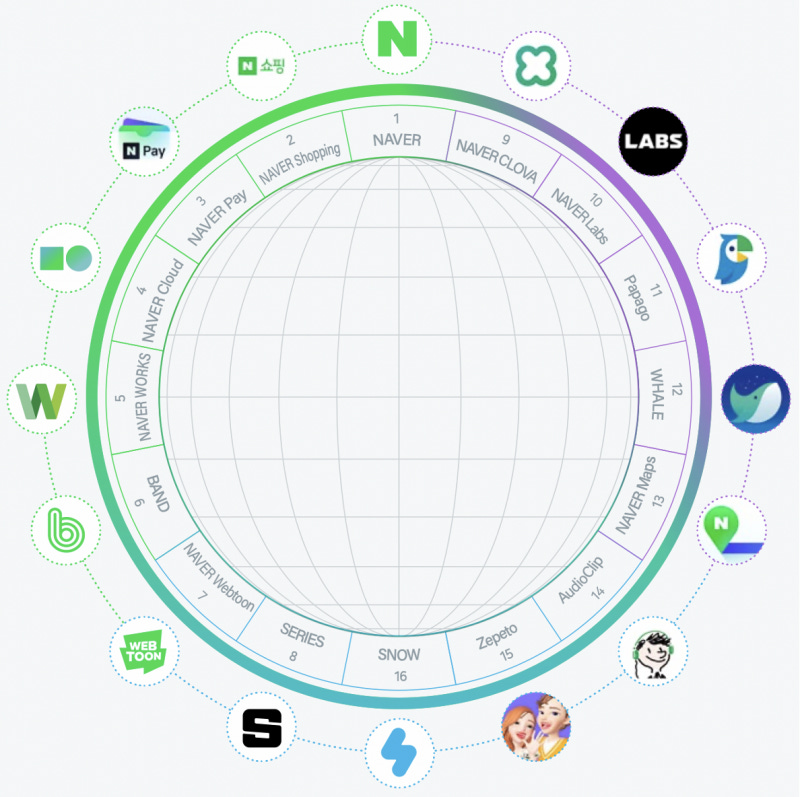
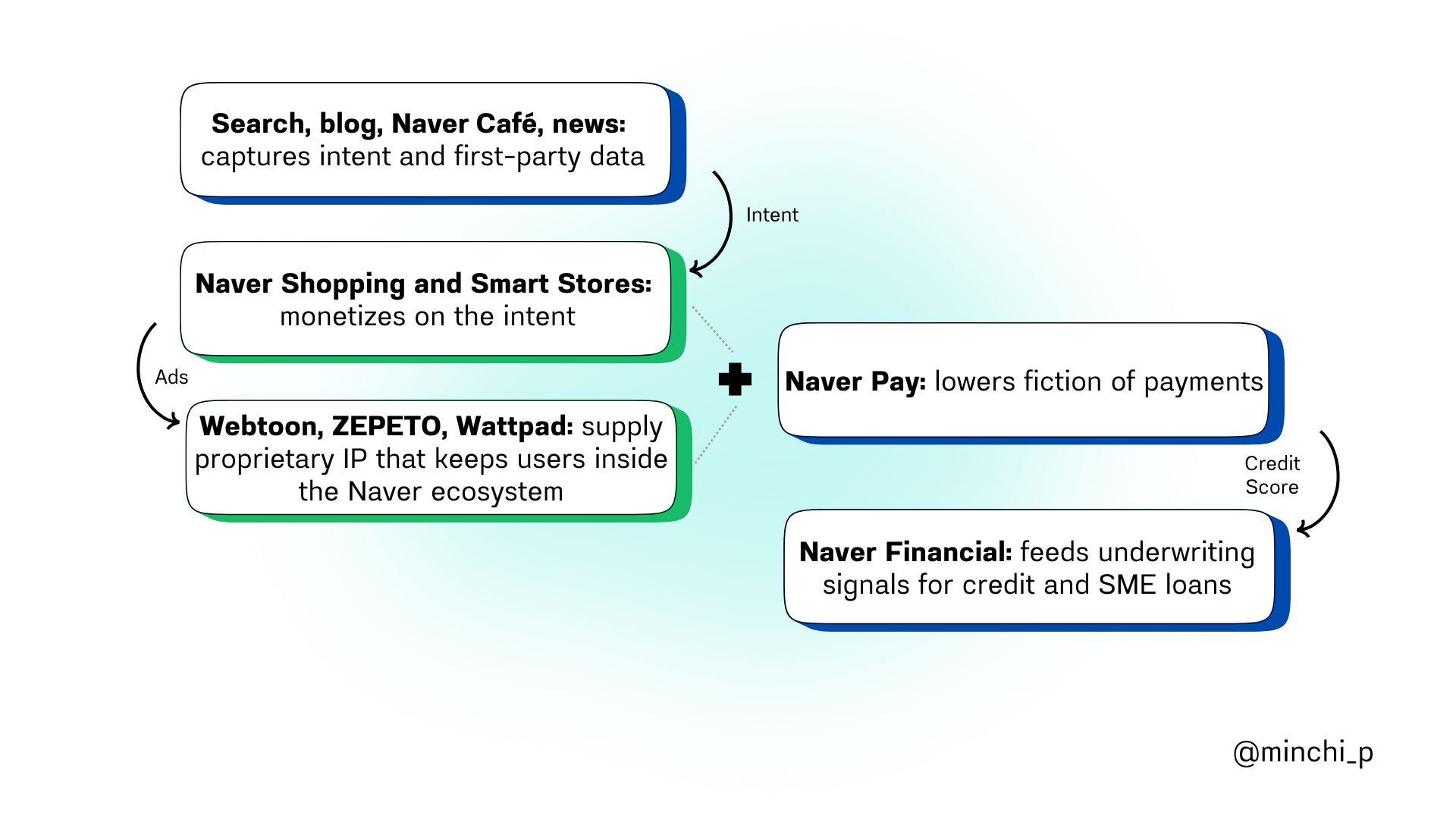
Naver’s ecosystem functions less as a loose portfolio and more as an interlinked operating system for daily life in South Korea, where search, commerce, fintech, content, cloud, and AI integrate seamlessly to drive discovery, traffic conversion, payments, personalization, and monetization in a tightly coupled flywheel.
Dunamu/Upbit’s Scale
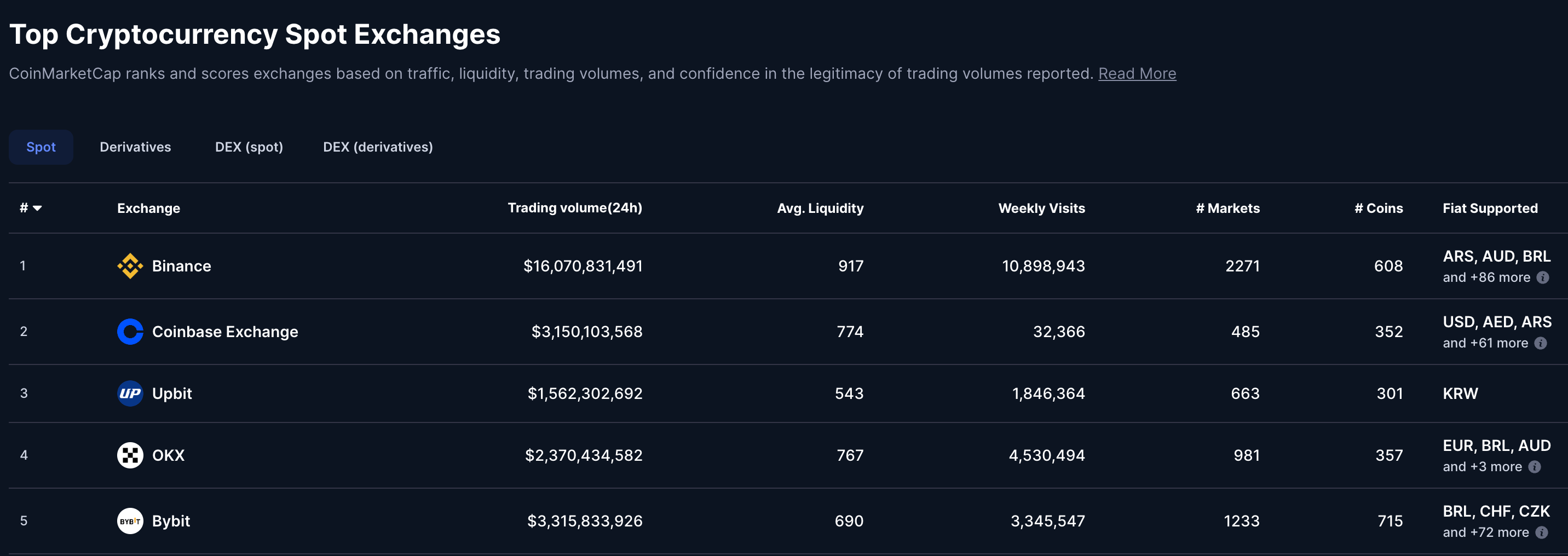
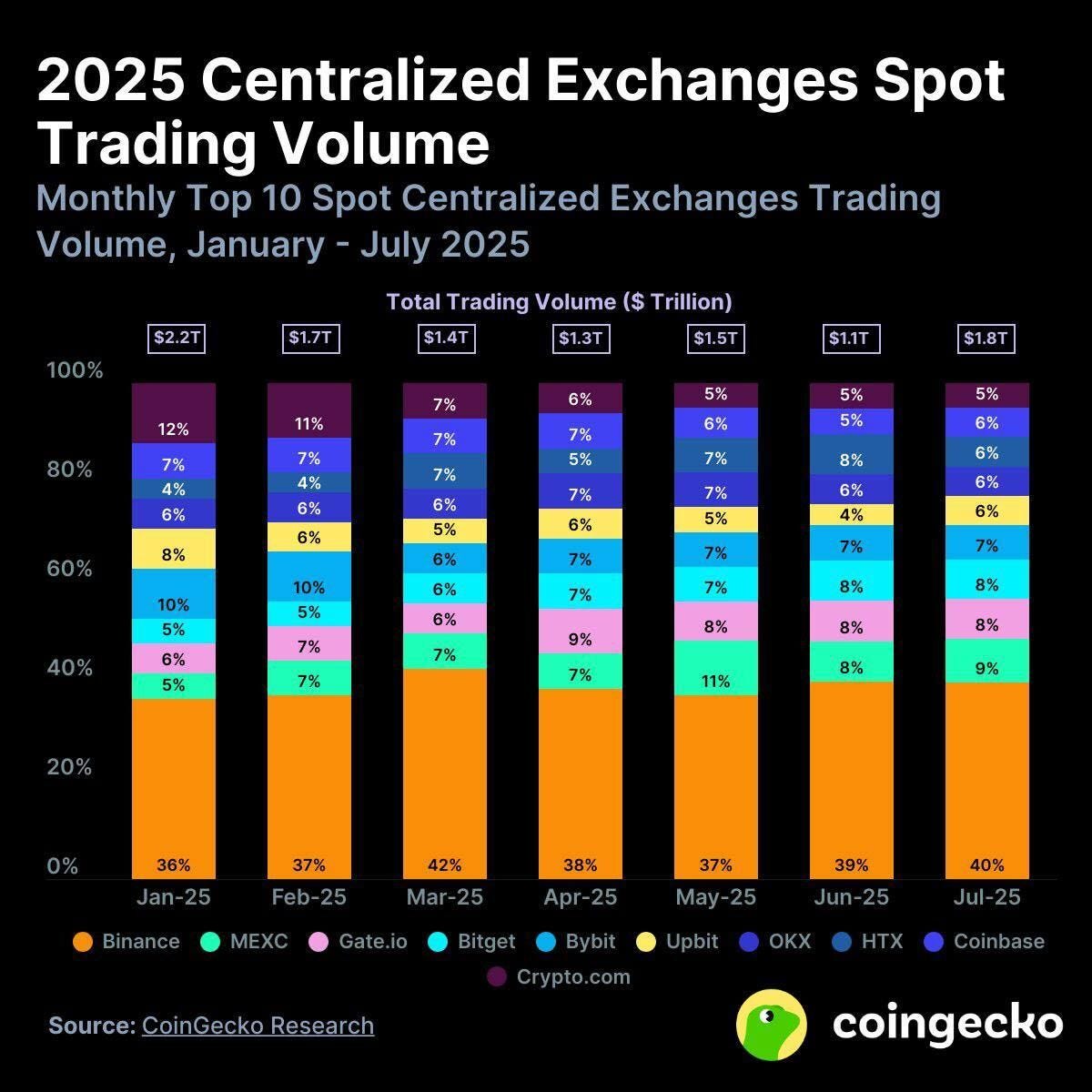
Dunamu operates Upbit, South Korea’s unrivaled centralized crypto exchange (CEX), commanding 69-72% domestic market share (peaked in H1 2025 at 71.6% market share with 833 trillion KRW in trading volume). It is also ranked at top five globally for spot volumes that fluctuate between US $1.8-5 billion daily with 15-16 million MAU. Despite near monopoly status in a nation of fervent retail traders, Upbit’s operations remain almost entirely confined to South Korea due to stringent capital controls, foreign inflow bans, and regulatory silos that isolate it from global liquidity pools.
Financially, it delivered KRW 1.19 trillion (~US $900 million) in revenue over the first nine months of 2025. It has generated US$ 165 million in net profits in Q3, which is a 300% YoY.
In contrast to Coinbase’s diversified, multi-jurisdiction model (custody, derivatives, USDC) across 100+ countries, Upbit’s economics remain concentrated in KRW spot trading. This hyper‑local focus has supported superior per‑user profitability in Korea’s retail heavy market, but it also hard‑codes key risks: single‑market exposure, policy headline risk, slower progress on enterprise partnerships, and limited overseas expansion. The result is a cash‑rich and highly profitable entity but strategically Upbit has little room to venture out into broader payments, stablecoin, and platform distribution.
Dunamu/Upbit needed the right partner with solid regulatory credibility and mass consumer reach, and that arrow points squarely to Naver and its financial arm, Naver Financial.
Why Naver Financial and Upbit Need Each Other
From a tech and equity lens, the industrial logic of this merge is clear:
Naver & Naver Financial:
Its core search, ads, and commerce franchises are mature and under pressure from shifting user behavior, global platforms, and a domestic rival called Kakao (which has built a broad everyday life ecosystem around its KakaoTalk messenger spanning fintech, mobility, entertainment, and gaming)
Naver Pay is a powerful wallet and payment solution but still sits predominantly on legacy bank and card rails, which cap unit economics and limit how far Naver can push margin‑rich financial products
The company is investing heavily in AI, especially its integrated agent “Agent N”, and needs new monetization vectors beyond ads if those investments are to translate into long‑term earnings growth
Dunamu/Upbit:
Upbit is the clear leader in Korea’s crypto market and generates high margin trading fees, but its growth options are constrained by regulation, public scrutiny, and concentration in KRW spot volumes
It lacks a mass market super app front end where crypto and, eventually, stablecoins become invisible plumbing beneath everyday spend (shopping, transport, subscriptions) rather than an isolated crypto trading destination
As a standalone crypto company, it carries outsized political and regulatory risk compared with a diversified, tech‑backed financial group, limiting its ability to form deep enterprise partnerships or scale internationally
The merger unlocks these constraints: (1) Naver gets a crypto-native rail with upside in stablecoins and tokenized finance and (2) Dunamu gets mass distribution, institutional cover, and a broader canvas for products.
What This Merger Enables in Practice
Pillar 1: KRW Stablecoin and Programmable Finance
The current South Korean administration under President Lee Jae Myung has made KRW-denominated stablecoins a centerpiece of his digital finance agenda. But for a single entity to carry the stablecoins agenda on their own in Korea will be extremely unlikely, even if its large corporations like Naver and Dunamu. Hence, the merger strategically positions both entities to be the right collision to carry out banking lobbies, navigate through political sensitivity, and coordinate with the necessary parties in the still-evolving digital asset rules.
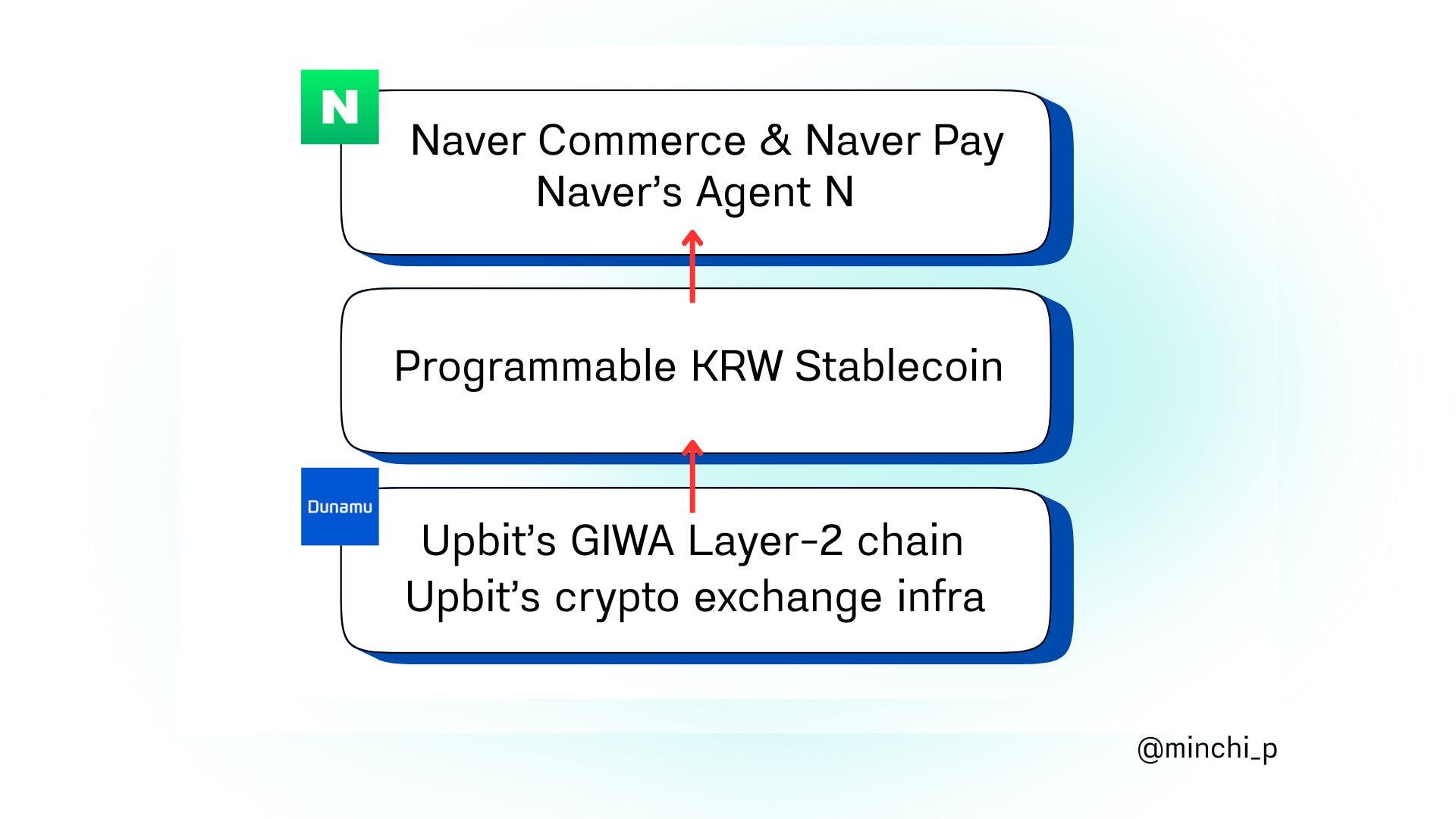
A core strategic outcome of this merger is a KRW-denominated stablecoin embedded in Naver Pay so it used as the payment asset in the wider Naver ecosystem. Dunamu’s blockchain stack includes Upbit’s GIWA Chain (a Ethereum Layer 2 for high‑throughput, low‑cost payments), crypto custody, and wallet infrastructure which provide the settlement and risk assessing engine. While Naver Financial contributes Naver Pay, merchant network, and mass distribution. In practice these could include:
Instant P2P and merchant payments inside Naver Commerce with KRW stablecoin under the hood but a simple Naver Pay balance for users
Programmable escrow, conditional refunds, and installment plans implemented in smart contracts rather than bespoke card‑network logic
Cross‑border flows for content creators (in ZEPETO, Webtoon, Wattpad, AudioClip), game studios, and vendors where a KRW stablecoin can act as a bridge asset with better speed and cost than traditional remittances
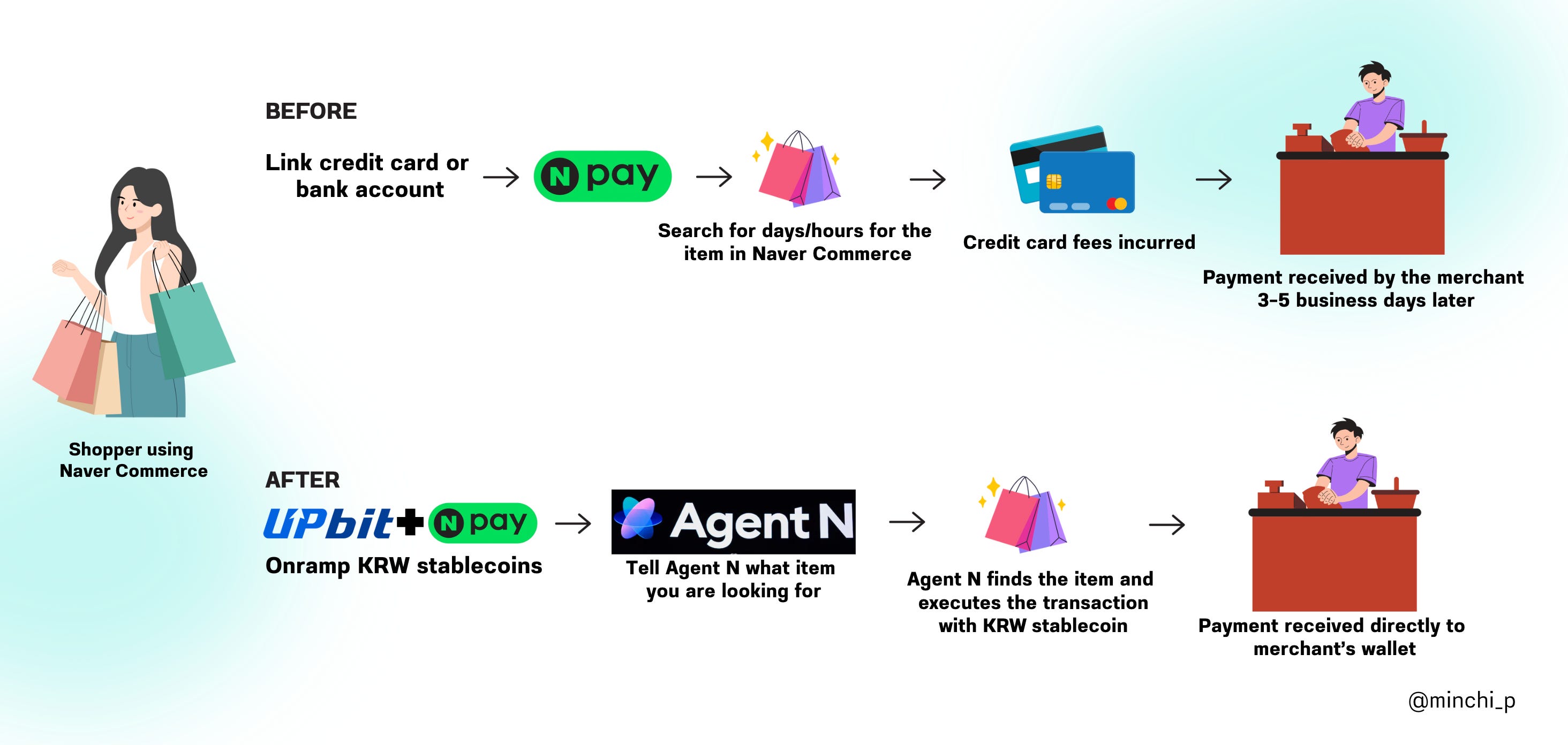
Economically, this shifts Naver’s payments mix from thin, fee‑based processing to a portfolio of float/yield on reserves, onchain service fees, and deeper financial product income, moving the model closer to a bank or securities platform than a pure PSP.
Pillar 2: Agentic Payments Inside Naver
Naver has launched an integrated AI agent strategy by introducing Agent N, an assistant spanning search, shopping, maps, media, and productivity. Early signals suggest this AI push is already lifting commerce growth, with a 35% YoY growth post Agent N integration.
As Agent N gains access to a blockchain‑based payment and settlement layer, the typical user journey shifts from the traditional search & click > ask, automate & transact model.
Suppose a shopper asks Agent N to find the best running shoes under 150,000 KRW and auto‑purchase a black, New Balance pair in size 37 if the price falls below 85,000 KRW. In the background, the agent continuously scans prices and inventory across Naver Shopping and Smart Store, and once it identifies a match, completes the purchase using KRW stablecoins already held in her Naver Pay wallet. If we take the power of Agent N event further, the user would not even need to specify parameters such as size 37 as the agent could infer preferences such as size, color, and favored brands from her past search and purchase history and apply them automatically.
Agent N ideally would be able to execute high‑frequency, low‑value, conditional transactions, manage refunds, renewals, and multi‑party workflows without human intervention. Legacy card and banking fiat rails are poorly suited to these 3V3Cs flows (high velocity, high volume, low value, conditional, cosmopolitan), due to fee floors, batch settlement, and limited programmability. Crypto and stablecoin rails, by contrast, natively support micro and nano payments, rule‑based settlement (escrow, pay‑on‑result, automatic refunds), and 24/7 global operations without bespoke bilateral integrations.
By bringing Dunamu in‑house, Naver can let Agent N orchestrate these payments with Naver Pay as the front end and stablecoin/crypto rails as the settlement spine, which means that from the shoppers and merchants’ perspective the experience will remain in Naver Pay.
Pillar 3: Naver’s Global Users Paying with KRW Stablecoin
Naver’s transaction‑heavy businesses (Naver Commerce, Webtoon, Wattpad, Poshmark, KREAM, Plus Store etc.) have historically been constrained by regional payment processors, card networks, and FX frictions, much as Upbit has been constrained by KRW rails and domestic capital controls. A KRW‑denominated stablecoin in the Naver ecosystem offers a way around those bottlenecks.
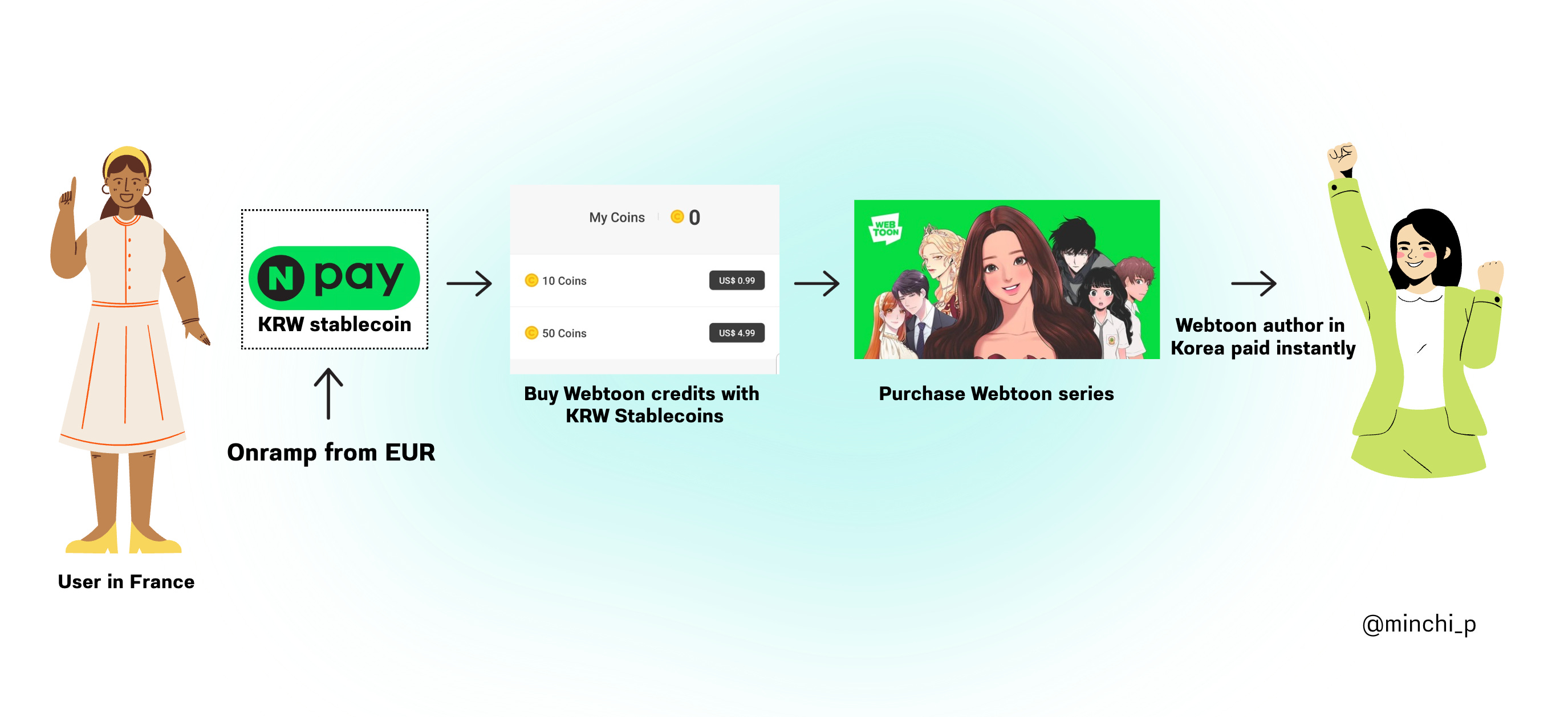
If a user from France, for instance, can easily acquire KRW stablecoins via a local onramp or another CEX, then they can buy a Webtoon chapter, tip a creator in Naver’s metaverse ZEPETO, or purchase K-beauty produces directly from Naver Commerce without incurring extra card fees or requiring Naver to negotiate and maintain separate acquirer and banking integrations in each market. In effect, a KRW stablecoin would shift Naver’s content and commerce stack from Korea‑only to globally addressable with a cheap and fast settlement layer that stablecoins provide.
In that scenario, Naver Pay also becomes a front‑end wallet for foreign users. Overseas customers could hold KRW stablecoins inside Naver Pay and use it as their default payment interface across Naver’s global content and commerce properties, rather than relying on third‑party processors or external custodial wallets.
Second Order Upside: What Lies Beyond The Obvious? (some creativity by the author)
Beyond the obvious synergistic points, the Naver Financial–Dunamu merger unlocks several second order opportunities that feel speculative today but could happen in the long-term future:
GIWA, as Naver’s “Base moment”
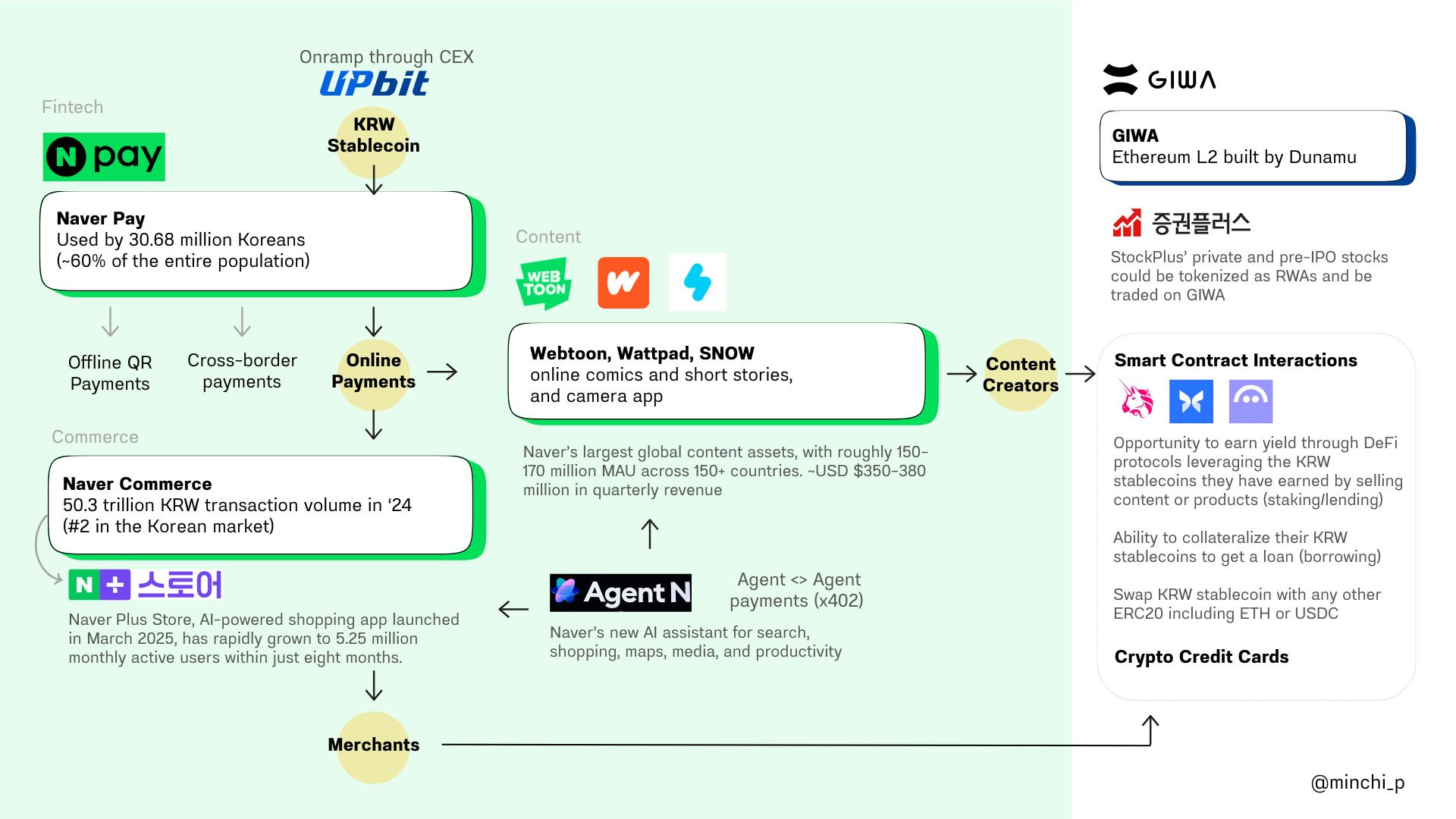
Dunamu’s GIWA chain, an Ethereum Layer 2 built with the OP Stack, positions the combined entity much like Coinbase and its Layer 2 chain, Base. The merged entity will control both distribution (Naver Pay, Upbit, Naver Commerce) and a programmable execution layer tailored to their ecosystem’s needs.
Just as Base hosts a rich ecosystem of DeFi dApps, GIWA’s compatibility enables developers to build decentralized finance protocols that interoperate seamlessly within Naver’s ecosystem. For example, a merchant accepting KRW stablecoins through Naver Commerce could deploy those stablecoins into GIWA-native yield protocols, generating returns without leaving the platform. This opportunity becomes even more attractive as historically DeFi yields are higher than traditional bank deposits.
StockPlus and Private Equity RWAs
Naver is acquiring StockPlus, Dunamu’s platform for trading unlisted and pre-IPO shares, as part of the November 2025 merger announcement. Private equity and late-stage venture positions are prime candidates for real-world asset (RWA) tokenization due to their size, illiquidity, and institutional appeal. Integrating Stock+ with Upbit’s custody, GIWA/KRW stablecoin settlement, and Naver’s compliant distribution creates a pathway to fractionalized, onchain secondary trading of Korean private stocks, for not only domestic retail investors and but also qualified foreign investors.
Nasdaq Optionality
Naver has proven its ability to spin out subsidiaries with standalone governance and list them internationally. LINE, its messaging arm, executed a dual IPO on the NYSE and Tokyo Stock Exchange in 2016, while Naver-backed Webtoon Entertainment went public on Nasdaq in June 2024, raising $315 million at a $2.7 billion valuation.
Naver has already shown that it can build standalone governance of a subsidiary and IPO it in an international capital market. LINE, its messaging arm, was spun out and made a dual IPO on the NYSE and Tokyo Stock Exchange in 2016, and recently in 2024, Naver-backed WEBTOON went public on the Nasdaq as well. Applying that playbook to the merged Naver Financial–Dunamu entity creates a compelling narrative for a future foreign listing (potentially Nasdaq) once regulatory milestones and earnings visibility are achieved.
TL;DR of the Merger
The transaction is an all‑stock share-swap: Naver Financial acquires 100% of Dunamu. Post-merger:
Naver Financial becomes the legal parent
Dunamu’s founder becomes the largest individual shareholder in the combined financial unit
Voting-rights delegation gives Naver effective strategic control while preserving crypto-native leadership in product and technology
Management is structured as a joint platform: Naver brings distribution, data, and regulatory relationships; Dunamu continues to drive trading, custody, blockchain, and tokenization. The companies have flagged a roughly 10 trillion KRW (~USD 7.5–8B) investment plan over five years into AI, crypto, and digital financial infrastructure, with repeated emphasis on stablecoins and global expansion.
Special thanks to Muharrem, Rohit, and Jessy for helping me review this piece.